Key takeaways
- The metro's interstates funnel toward the river and the Poplar Street Bridge, and the approaches are where traffic stacks up and the low-speed rear-end hit happens.
- A rear-end hit at fifteen to twenty-five miles per hour leaves little body damage and a loaded lumbar spine. The soreness arrives a day or two later.
- Tesson Ferry sits off the I-270 and I-55 side of south county. Hazelwood sits near I-270 and I-170 in the north. O'Fallon sits on the I-70 corridor in St. Charles County.
- Pick the office on the corridor you already drive. A sore back does not want a new route.
St. Louis is a city of interstates that all want to be in the same place at the same time. I-55 comes up from the south, I-44 from the southwest, I-64 from the west, I-70 from the northwest, and I-270 wraps around all of them. Most of them end up pointed at the river and at the Poplar Street Bridge. That geometry is why this desk hears about the same crash over and over: a line of cars slowing on an approach ramp, one driver a half-second late, a bump at twenty miles per hour, and a back that reports in on Tuesday.
Why the low-speed hit is the one that hurts
A high-speed crash is an emergency and it goes to an emergency department, full stop. The crash that sends readers to a planned exam is the slow one. At fifteen to twenty-five miles per hour, bumpers absorb most of the visible damage and the cars often drive away. The bodies inside did not get that courtesy. The seat drives the pelvis and torso forward, the belt holds the hips and one shoulder, and everything that is not strapped down, the head, the shoulders, the unsupported parts of the spine, keeps moving and then snaps back. The National Highway Traffic Safety Administration's seat belt page at nhtsa.gov explains why that trade is worth making every time. It is also why the lower back, the neck, and sometimes the head are what hurt two days later. The crash chapter walks through that delay hour by hour.

Corridor by corridor
I-55: the south approach
Up from Arnold, past the Meramec, through south county and along the south city riverfront to the bridge. Morning traffic stacks from the I-270 interchange north and again on the approach downtown. This is the corridor most of this desk's readers drive, and the Tesson Ferry office sits just off it in the 63123 zip, a few minutes from the I-270 and I-55 side of south county. The south side reader's guide covers the last mile.
I-44: the southwest approach
In from Eureka, Fenton, and Kirkwood, through Shrewsbury and the south city neighborhoods, merging with I-55 before the river. The merge is the pinch. Readers on I-44 inside I-270 are generally closer to Tesson Ferry than to any other office; readers out past Eureka should check the drive time to O'Fallon as well.
I-64: the west approach
The Chesterfield valley, Creve Coeur, Clayton, Forest Park, downtown. Forty, as the city calls it, is bumper-to-bumper in both directions at rush hour and its lane drops near the Kingshighway and Hampton stretches produce the classic slow-speed bump. West county readers split: south of 64 tends toward Tesson Ferry, north of 64 toward Hazelwood, and the Chesterfield valley often finds O'Fallon a straight shot west on 64 then north.
I-70: the northwest approach
From Wentzville through O'Fallon and St. Peters, across the Blanchette Bridge into St. Louis County, past the airport, and downtown. The O'Fallon office on West Terra Lane is on this corridor in St. Charles County, and the Hazelwood office is just off it on the St. Louis County side near the I-270 and I-170 interchanges. Readers in the 70 corridor west of the river generally call O'Fallon; east of the river and around the airport, Hazelwood.
I-270: the ring
The beltway connects every other corridor and carries the cross-county commute that never touches downtown. Its interchanges, at 55, 44, 64, 70, and 170, are where the slow-speed hit happens in every direction. The good news for a sore reader is that two of the three offices sit close to it: Tesson Ferry on the south arc, Hazelwood on the north arc.
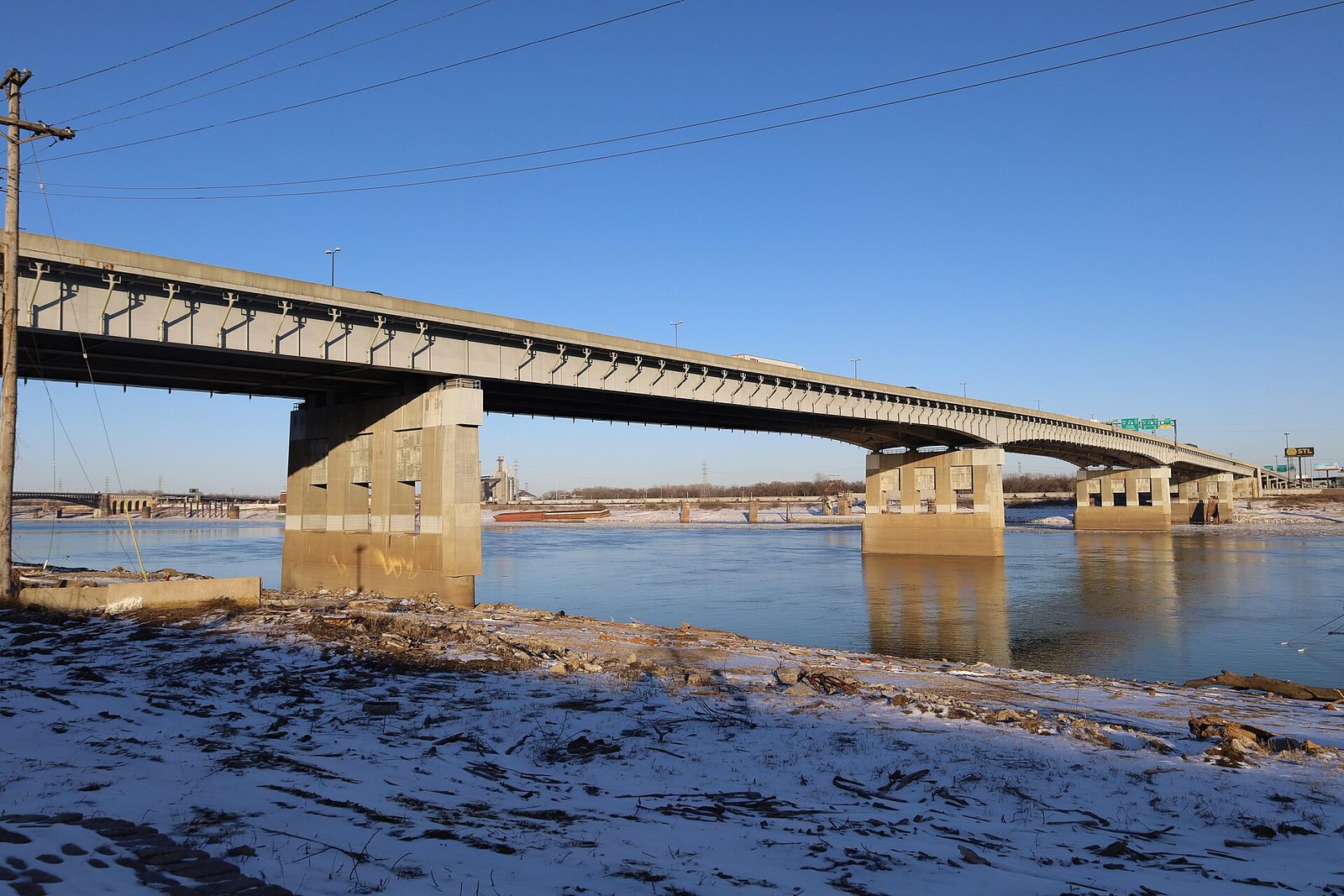
The Poplar Street Bridge
Where I-55 and I-64 cross the Mississippi together, with Illinois traffic feeding in from the east. The approaches on both sides are the metro's most reliable backup, and the rear-end hit on the ramp is a daily event. Metro East readers crossing the bridge for work are, for practical purposes, south city readers: the Tesson Ferry office is the drive that makes sense.
The commute crash, specifically
The commute crash has a signature. It happens at a time of day when you are already late. It happens in a line of cars, so there is a witness in every direction. The damage is small enough that everybody wants to exchange information and leave. And the injured person is the one who was stopped or nearly stopped, braced or not, who says "I'm fine" because nothing is bleeding and the car still drives.
The guide's advice for that person is the same as everywhere else on this site. Write down the time, the road, the direction, and whether you were stopped. Get home. Pay attention on day two. If the back, the neck, or the head start reporting in, call the office on your corridor in the morning and say it was a crash. A documented exam this week protects your health and your options, and you do not need to have decided anything about a claim before you get examined.
Driving the corridors sore
Between the crash and the exam you will probably drive the same road again. Seat a notch more upright, lumbar support, mirrors set so you twist less, and a stop to stand on anything over half an hour. The week between has the full list. And the bright line still applies at seventy miles per hour: Chest pain, a sudden severe headache, weakness or numbness on one side, trouble speaking, a loss of bowel or bladder control, or a head injury with vomiting or worsening confusion is an emergency room trip right now, not a call to a clinic.
Featured clinic · Missouri Injury Clinic
Call the office on the corridor you already drive.
Tesson Ferry off I-55 and I-270 in the south, Hazelwood off I-70 and I-270 in the north, O'Fallon on I-70 in St. Charles County. Morning calls; every office closes from 12 to 2.
Advertising. This guide is compensated for featuring Missouri Injury Clinic. Joseph L. Hollingsworth, DC, is a chiropractor, not a lawyer. Hours are worth confirming on the call.